The XX – Coexist

Rating: ★★★½☆

Back in 2009, The xx made their way into the hearts of indie fans with their sleek and sensual first album. It was breathy, moody, electronic, and danceable: a combination of elements that seemed to strike resonance in younger audiences with their minimalist R&B sound. Consisting of guitar, bass and drum machine, the first album made waves and ended up atop a lot of year-end lists as this band transitioned from unknown to popular in the scope of the indie world in their buzz-band success. Now, three years later, Coexist begs the question: can this band power through their rapidly achieved success and be more than a buzz-band?

The two songs that they released as singles make their appearance early on this sophomore release. “Angels,” is up first, and it serves to introduce the band’s new sound. The familiar deep and soft vocals of lead female vocalist Romy Madley Croft greet you, along with impossibly more minimalist backing instrumentation.  It’s a slower, mellower track, which is a common theme for this album. The next song and other single “Chained” picks up the pace, with a faster beat provided by the drum machine, and a groovy guitar riff towards the end. Both of these songs provide a palette for the rest of the album, as most of the songs fall under the categorization of these two tracks. Other immediate standouts include “Sunset” and “Swept Away,” which fall as more musical and sonically interesting tracks.

It’s difficult to categorize this album as either interesting or fairly dull when it is so far in the shadow of the first album. At first glance, the sound of Coexist feels overwhelmingly empty; it’s missing those sharp guitar riffs that made the music edgy and playful in the first place. However, when you’ve gone through the album a few times and let go of your qualms that it’s not, in fact, the exact same tone of the album that was released three years ago, this collection of songs becomes a natural progression for The xx. The group relies less on breakdown after breakdown and focuses on a deeper, more somber overall sound. You won’t find the overwhelmingly playful waves of electronic elements that previous tracks, such as “VCR,” but instead you’ll find that waves that don’t bounce quite as high, keeping a lower profile.

Coexist is very much a sophomore album in that the band progressed their sound, making it drastically different from their first album and garnering a label of ‘maturity,’ which allows them to move past the hype and establish themselves as a sold Such a change can be noted even upon the differences in the artwork of these two releases. The first is stark, with harsh lines in a bold, black and white display, whereas this album displays the same ‘x,’ but with a soft swirling of color on the inside. What will be different about the design of the next album, and will this band be able to progress yet again, while keeping the fans of their original sound?

Will Johnson – Scorpion

Rating: ★★★☆☆

Will Johnson is one of the most active musicians in the state of Texas, and, well, out of it too; he’s the main man for Centro-matic and he played drums on tour for Monsters of Folk.  But, I’ve always had an affinity for his solo work, ever since I first put on Vulture’s Await.  On Scorpion, his new solo record, we’re once again treated to an intimate affair, one that’s ultimately heartfelt and captivating.

If you’re not accustomed to Will Johnson‘s music, then you might be taken aback a bit at first when you press play to hear the first track, “You Will Be Here, Mine.”  True, it’s a pained rasp, but the more you listen, the more it becomes one of the most endearing voices you’ll hear.  This particular track has Will crooning as a very down-trodden percussive element backs his careful guitar picking.  You’re not going to feel uplifted here, but you’ll find personal solace in this tune.  Oh, and the semi-eruptive closing is quite beautiful. Similarly, “Bloodkin Push (Forget the Ones) takes a down turn in tempo, with Johnson’s voice clearly remaining the key instrument in the track; there’s also a faint backing vocal that truly helps deepen the mood.

I kept looking for a remake of “Vultures Await,” though admittedly that’s not fair to expect from an entirely different collection of songs, especially when the songwriter seems to put so much of his person in his songs.  There are a few tracks that near the perfection of the aforementioned number such as “Blackest Sparrow/Darkest Night” and “Truss of Ten.”  The former features a calm delivery, which reveals the faintest hint of Will’s natural vocal melody; this is the voice that has affected me for so long.  On the latter of the two tunes, there’s barely any instrumentation, aside from muted guitar strokes that eventually make way for some light picking.  However, this song is all about the vocal performance, with Will again joined by a counterpart with a softer side, contrasting his harder edge.

By and large, Scorpion is much quieter than the last full-length project.  Where the past efforts saw his voice attempting to soar, Will seems much more alone here.  You can’t help but be drawn in by a track “Scorpion,” even though there’s not much to the track itself.  A bit of far off tinkling piano, some backing vocals and gentle strummed guitar are all that exist to show us that Johnson’s not entirely alone out there.  This is about as personal an experience as a listener can get nowadays, as if he’s writing these tracks in the back of your house while you sit outside the door.

This listening experience is quite different than where I feel like I expected it to go after fawning over Will Johnson‘s previous works, both with band and without.  While I appreciate a more musical approach, I think Scorpion succeeds in being the exact opposite.  It’s a record you want with you while you’re alone, giving you the feeling like you have someone with whom you can share your solitude.  There’s no way you can listen through this whole record without having a huge emotional reaction, and I’m always thankful Will can provide us with that.

[audio:https://austintownhall.com/wp-content/uploads/2012/07/01-You-Will-Be-Here-Mine.mp3]

Download:Will Johnson – You Will Be Here, Mine [MP3]


Dot Dash – Winter Garden Light

Rating: ★★★★☆

When I first stumbled upon DC’s Dot Dash, I had the impression that the group was aiming follow in the footsteps of their namesake, which might have been true on the first record.  But, with Winter Garden Light, the group has altered their sound, creating a warmer collage of pop tunes infused with melody and excellent guitar sounds.

From the instant that “Faraway” blasts through your stereo you can see that the softer side of Dot Dash is about to break through.  Terry Banks’ vocals have a softer tone on this opener, and the guitars seem to have a brighter quality in comparison to the earlier work of the group.  But, at times you can still hear the jagged edge of the band in their sound, fueled by the buzzsaw guitars near the end of the song.  At first, I had to alter my perception of the group, but after the opener, “Countdown” sold me on the group’s progress. Light backing vocals add some emphasis to Banks’ voice, which soars during the chorus.  I feel as if there’s an Oceanic vibe in the guitars, and once it’s combined with the group’s pop leanings, it comes close to perfection.

One of the songs that really sticks out on Winter Garden Light is “Live to Tell.” Beginning with a sort of spoken word atop minimal percussion and faint guitars, it then jumps into a swirling bit of guitar that captures you emotionally as Terry moves into his singing stance.  But, what I really like is how the band juxtaposed this track in the sequencing with “The Past Is Another Country,” which is one of the heavier hitters on the record.  While there’s a punk rock urgency to this number, it still holds some semblance to great pop writing, especially in the vocal approach. Together, these two tracks are a perfect one-two punch that demonstrates the bands abilities to go back and forth between traditional indie rock and lofty pop.

Personally, when listening to Dot Dash I like the element of restraint they’ve shown in their songwriting.  Amidst today’s musical landscape, they somehow manage to hold back on just filling your ears with walls of controlled feedback on the guitars.  You can see hints of all-things-gaze in tracks like “Lateral/Vertical” or even “Two Octobers,” but they hold it down in the mix, which really allows for the other elements to push through.  Using such techniques shows me that they’re not aiming to be just another band behind Pains of Being Pure at Heart, but rather a group with their own definitive sound, albeit one you can trace back through various lineage.

At the end of the day, I’m happy to have stumbled upon Dot Dash, as they have proved to me that they’re a group with their own distinctive voice.  It’s great to have influences, and even to wear them on your sleeve, but when you make it your own, that’s when you’ve proved your mettle.  In my eyes, Winter Garden Light is just that sort of record, giving you glints at the band’s record collection, but begging you to look at them as their own entity.  Consider that mission accomplished.

[audio:https://austintownhall.com/wp-content/uploads/2012/09/Dot-Dash-Winter-Garden-Light-01-Faraway.mp3]

Download:Dot Dash – Faraway [MP3]


Jens Lekman – I Know What Love Isn’t

Rating: ★★★★☆

When it comes to classic indie pop, Americans sure do love their foreigners. Whether it be the infamous pop darlings hailing from Glasgow, Belle and Sebastian, or the like, we do love a good soft spoken pop band and so it’s no surprise that Swede Jens Lekman has been a force to be reckoned with since his debut album released in 2004. Since then, his delicate tones have made their way into the hearts of many, perhaps owing to the melancholic brightness that can be found on any given release from this man.

And if it’s sunny melancholia you’re looking for, then I Know What Love Isn’t is surely the right place for you to be. It’s clear from the title that this will be an album about the lack of love that Lekman has grown familiar with and with this, comes the implication that these songs will reflect upon a failed relationship and the desire to move on to something better that resembles the love that Lekman hasn’t found yet. The album opens and closes with two tracks by the same name that serve as the front and back covers of this somber story. Both of these numbers run along the same lines, but the opening “Every Little Hair Knows Your Name,” is solely piano, whereas the closer elaborates and expands to a track that matches the others on this album. The first track trickles in faintly and gently—the piano generating a sorrowful, yet hopeful tone to start things off. It’s a beautiful little number that helps set the stage for the rest of the songs to follow.

“Erica America,” picks it up a bit into the pop world, carrying the piano in from the first song but also introducing the other elements of a Jens Lekman track. Lighter than air percussion, natural acoustic guitar and the sleepy vocals of Lekman resound strong and smooth, combining with a saxophone solo and some chimes towards the end to produce the juxtaposition light and dark elements. Lekman sings “I wish I’d never met you,” and other regretfully heavy sentiments that contrast the bright and clear instrumentation; a residual theme across the album. There are plenty of catchy tunes on I Know What Love Isn’t, such as “Some Dandruff on Your Shoulder,” as well as the title track. Along with these catchy pop numbers are also some slower numbers that provide for some interesting recesses, like “I Want a Pair of Cowboy Boots,” that express some rather bitter emotions.

Mr. Lekman knows what he is doing; each song stands alone, strong enough to hold its own, but all together they form a snapshot of the emotions and stories that combine to generate an album professing the same thing without getting repetitive and dull. Such is a great feat in today’s age of singles.

Animal Collective – Centipede Hz

Rating: ★★☆☆☆

I realize, of course, that Animal Collective is one of the most divisive bands in the indie world, admittedly acknowledging that I’m the only on this site that has any interest in the group.  So I set out to listen to Centipede Hz aiming to prove a point, hoping to convince my partners that there’s something worthwhile about this band and their recent album.  Honestly, I struggled, barely making it past the first song on the first few listens.

“Moonjock” is an awful choice for an opener.  It’s possibly one of the worst recorded songs I’ve heard from this band, with little focus in the way of song construction.  At times it’s grating, and at other moments, it’s just plain awful.  But, while I can’t stand this song, I found a little bit of solace in the following track, “Today’s Supernatural.”  It’s not going to catch you with powerful hook-laden beats, such as the group’s done before, but the basic outline of the song does work to a certain extent.  However, the group seems to get lost in the plot with the extensive shouting, and then it sort of falls out flat.

As a fan of the band, I was looking for that statement track on Centipede Hz, sort of like “My Girls.”  While it may not have the lofty pop moments, “Applesauce” is probably the standout track in a record with so few.  The vocal effect here isn’t quite as offensive, and the hidden melody does appease my ears; they’re also as playful and joyous as the group can be at the best of times. If I had to pick another track that fit into a similar place on this album, then I’d probably pick “Pulleys,” although this is the most un-Animal Collective track to my ears.  It’s almost holds onto a dream-pop quality, but the weak percussion holds the track back just a bit, keeping it from being a true star here.

Each time I listen, something new pops up, which typically is a great thing for any music listener, but these aren’t necessarily great things that reveal themselves to me, rather they’re the elements of what seems like a tired formula.  For instance, on “New Town Burnout,” you’re going to find the percussion/drum loop uninspired, and the vocals don’t do much more to aid the cause.  Or, maybe you’ll go to the miserable vocal performance on “Wide Eyed.”  I’m not sure what I dislike about it necessarily, but for a group that’s made their name fitting erratic vocals into careful pop construction, this seems rather lackluster.

All in all, I definitely have a few songs on Centipede Hz that I can enjoy in the near future.  But, that being said, I will definitely stand by the fact that this is the first Animal Collective record that’s probably not ever going to be played again on my record player from start to finish.  There are simply too many songs in this collection that are unlistenable, which I’ll admit makes me sad.  I didn’t expect a repeat performance after Merriweather Post Pavilion, but I definitely had something stronger in my dreams than this.  Perhaps their formulaic (albeit an abstract formula) writing style has run its course. Perhaps the band has run its course.  Only time will tell, but at least we’ll always have records like Feels to fall back on.

Cat Power – Sun

Rating: ★★★½☆

Cat Power, or rather, the woman behind the moniker, Charlyn Marie Marshall, is essentially a staple in a great deal of self-professed indie music fans. Since as early as 1995, Cat Power has been releasing albums, though the success of Marshall has been debated over the years, as her live performances showed signs of her degradation from problems with alcohol. That was back in ’06; in ’08 Jukebox surfaced and showed signs of revival, though far from a knockout record. Now it is 2012…has this front woman and backing band put the “power” back in their name?

Starting things off on a wonderfully groovy note, “Cherokee” opens on a bubbly note. Simmering in its slow, rolling drumbeat and its angled guitars, it slowly builds, layering sounds so that you focus on Marshall’s purr of vocals, whose transfixing, yet subtle elements blow other female vocalists (i.e. Lana Del Ray) out of the water. The tone of the track is kept pretty mellow throughout due to the steady percussion, but the vocals push it further and further, each chorus swelling. Marshall spits her words out quickly, relying on assonance to aid her in the flow of the lyrics and you’ll be singing along with her, joining in on the chill and yet stimulating opener. Akin to that hiss you hear when you twist the cap on an ice-cold soda, “Cherokee” is a sure sign of good things to come.

A similarly catchy number that follows a song later is “Ruin,” on which the fluidity is still present, but the song comes across with more a pop sound due to piano sounds, and a more casual approach to the percussive elements. The instruments all bleed into one another, and yet have their place at some point at center stage in the song, which is owed to the tone that the group has established early on in the album. As the album progresses, Cat Power hits you back to back to back with effortless, yet stylistically complex tracks that allow for total immersion in the music a quality that felt a little lost on past efforts.

So the answer to the question aforementioned is yes—Marshall is on point in her songwriting and the instrumentation on Sun enhances the seductive, but never lewd, prowess of such a front woman.  Fans of Cat Power will rejoice, while newcomers will find another artist to enjoy; it’s a solid enough of an album to induce interest in the entirety of the songs created by this band, which is what any already established band can hope for.

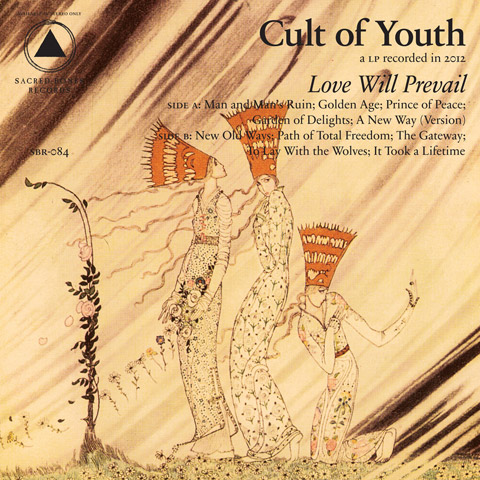
Cult of Youth – Love Will Prevail

Rating: ★★★½☆

There seems to be a lot to the storied past and present of Sean Ragon, the lead man behind the Cult of Youth outfit, but I wonder if that’s even relevant nowadays.  Where he began is probably not nearly as important as where he’s ended up, crafting another beautiful record, Love Will Prevail, that combines elements of folk, punk and perhaps even hints of more experimental works we needn’t delve into at this point.

“Man and Man’s Ruin” begins the entire affair with a dominant strummed guitar while a tribal tom echoes in the background, setting the scene for Ragon’s deep vocal to tell the story.  For me, there’s a great bit of restraint shown in his delivery, something that came often on the last Cult of Youth record, but not quite often enough.  Of course, he can’t hold back forever, unleashing his throaty yell as a female counterpart fades in and out.  As an opener, it demonstrates a warmth on Love Will Prevail; it’s almost a quieted affair.  A similar demonstration of this touch comes in the way of “Prince of Peace,” which uses a vocal effect (recording procedure) that creates a backing group for his voice.  Personally, I’m always affected when his first grows deeper and louder in the mix.

But, while Love Will Prevail spends a great deal of its time on the softer folk side of Ragon’s influences, there’s still some punk ethos in what he does.  “Path of Total Freedom” is a short number, but it earns its inclusion here with its usage of horns atop the rocking sea shanty.  Just listening to it I can imagine my old friends stomping about as beer spills from their hands onto the floor…a nostalgic image, but a good one.  Earlier tracks such as “Garden of Delights” also provide an element of darkness that I’ve come to appreciate in Sean’s music.  The interesting bit is the electronic feedback that’s used in the middle of the track, adding that experimental touch to the group’s neo-folk-punk sound; blaring horns continue to up the ante.

While Cult of Youth definitely holds onto a heavier side of folk, I will always fawn over tracks like “To Lay With the Wolves.”  On this number, the group perfects the loud quiet loud quiet formula that’s been fashioned by their forefathers. Interestingly, it always has this live emotion to it, as if the recording process has allowed Ragon to stand before you, presenting you with his craft.  In my eyes, this is the statement track of the record, giving you hard and soft qualities, while still playing with bits of creativity that are sure to be appreciated.

In the end, Love Will Prevail is more than successful.  On many accounts, it would be easy to lump the group in as just any other folk revivalist group fronted by a former punk rocker, but there’s so much more to it.  Splashes of experimental sounds, light backing vocals and appropriate horn usage push the envelope, and in doing so allow for Cult of Youth to make a statement: they’re more than just your average neo-folk group, and we’re all better off for it.

[audio:https://austintownhall.com/wp-content/uploads/2012/07/01-Man-and-Mans-Ruin-1.mp3]

Download:Cult of Youth – Man and Man’s Ruin [MP3]

Love Will Prevail is out now via Sacred Bones Records.

The Fresh & Onlys – Long Slow Dance

Rating: ★★★★☆

I listened to this record 8 or 9 times, all along thinking it was on the verge of either a 3.5, but not quite.  I figured my love and adoration might just push it over the edge, so I gave it a few more spins. Then it hit me, Long Slow Dance is perhaps the most focused and complete the Fresh & Onlys have completed up to this point in their short career.  Given, they’ve stripped away a little bit of the reverb, but it makes way for a clarity that is really appreciated by those following Tim Cohen and company.

“20 Days and 20 nights” opens with a bit of a catchy jangle, holding back on the pace just a bit.  It allows for the perfect introduction to a more polished-sounding Tim Cohen. His voice sounds steady, rather than wavering in the hazy distance as you’ve come to find on Fresh & Onlys records. If you listen closely this time around, you might even catch a bit more emotion in his voice–it’s barely audible, but listen closely.  For me, an avid fan, it all indicates a more confident singer, and group for that matter.  Years ago I couldn’t have imagine them creating tunes like “Long Slow Dance,” which closely resembles a folk ballad.  Percussion is turned down low, giving the strum of the guitar and the dancing tambourine a little bit more emphasis.  While they hold back in spots, they do unleash a little bit more power in various spots.

My first notice was “Yes or No?”  Once that guitar enters accompanied by the drum, you know exactly that these guys mean business.  Like most tunes on Long Slow Dance, it’s clearly linked to the annals of the band’s previous works, just with more punch. Or, you can listen to “Euphoria,” which again utilizes more pronounced drum work, not to mention some cascading guitar-lines. Honestly, the first ten second almost gave me a punk rock feel–that’s until Tim came into haunt the track with his heavy vocals. And, such emphatic songs are great in the scheme of things, but I really like the extra touches outside of the group’s normalcy that they’ve chosen to include.

Have you listened to “Fire Alarm?” It’s got a strong electronic bent to begin, and while that remains slightly in the back, there’s a definite groove that doesn’t sound too familiar on most Fresh & Onlys albums, being one of the reasons I really like it.  Take the group’s psychedelic touch, mix it in with hints of the 80s swatch, and you have one of the most intriguing songs on the record. Or you might want to take a look at “Foolish Person,” where you’ll find the band flirting with touches of modern pop construction, using Tim’s vocal to captivate listeners while the rest of the posse work their magic…and then it just blasts off into experimental noise to wrap out the 6 minute track.  There’s not much else like it in the band’s catalogue.

While I may have been on the fence a bit, that’s just my own idiocy. Long Slow Dance finds the San Francisco group mixing in newer influences and stronger studio production to knock this one out of the park.  You know Fresh & Onlys can write great songs, but this time they’ve written twelve, using every bit of their influences to create a refreshing record that only gets better the more you listen.

Poor Moon – s/t

Rating: ★★★☆☆

Side project of two members of Fleet Foxes or not, Poor Moon is essentially the child of Christian Wargo, bassist/vocalist for the aforementioned band. For years, Wargo wrote and recorded songs on his own before he decided to bring along Casey Wescott, as well as Ian and Peter Murray to help bring his bank of demos and songs to fruition. Thus was born Poor Moon—a band to adapt a collection of songs into a collective album.

Naturally, with musicians from such a well-known band in the folksy/indie scene, people will be drawn to Poor Moon for its ties, but those who come looking for the vast dependency on warm harmonies and big, swelling folk sounds will have to keep on looking, because for the most part, this effort showcases folk sound on a smaller, minimalist scale. Take the first song “Clouds Below” for example, begins with some gentle guitar plucking and the soft vocals of Wargo, which meander in coolly, harmonizing with the impossibly higher backing vocal to create a serene and simple opener. This sets the tone for the album, alluding to signs of a peaceful, folksy sound.

But, the band picks it up a bit from where they leave you after “Clouds Below” especially on the third track “Same Way,” where things get groovy. One of the strongest on the album, the song employs some opening ‘ooh’s’ and is backed by strong melodic xylophonic sound as well as big echoing drums that fill the previously empty background of the song. There is a quite an enjoyable breakdown towards the end of the song that is just long enough to give you a taste of the musical ability of the members of this band and it makes you desire a bit more depth from the songs of Poor Moon. Through the rest of the album, you listen for little pieces of this depth that the band demonstrated on this song, but sadly they are in short supply. It isn’t the lengthy and full storytelling and serene folk album that feels right for the genre and it comes across as a group of songs that were forced to sound similar, as opposed to the authentic and natural production of an album.

Most of the songs are relatively short for folk numbers that are reaching to be meaningful and impress a feeling upon their listeners, which leads me to my biggest complaint about this album; there just isn’t enough on here to really make an impression on those who take a listen the first way through. With repeated listens, it’s possible to grasp and really hold on to the music that has been so meticulously laid out for its audience.

Divine Fits – A Thing Called the Divine Fits

Rating: ★★★½☆

When there is a collision of famous indie artists, it’s not really an exaggeration to say that the internet world blows up a bit. So a few months back when this project between Indie darlings Dan Boekner, Britt Daniels, Sam Brown and Alex Fischel came to the surface everyone was abuzz with excitement for their debut album. As a fan of Spoon and Wolf Parade/Handsome Furs, the main projects of which Daniels and Boekner are frontmen, I jumped right on the excited bandwagon. How could this much creative genius combine to equal something less than amazing?

First up on the album is the much hyped single “My Love is Real,” which features Boekner taking the lead on vocals and a heavy amount of synthesizer and other electronic sounds. It’s an interesting start, as it is a pretty straightforward song, lyrically and sonically. You have the steady drum machine beats, some thick synth lines and Boekner iterating that “[his] love is real…until it stops;” a tangible one liner that can get itself stuck in your head for hours at a time. Next up is “Flaggin’ a Ride,” on which Daniels takes vocal lead. Noticeably, it sounds a lot more like Spoon, as the first song exhibited signs of Handsome Furs. Apart from the vocal similarities, you have the signature guitar lines that takeover the song and the overall rockier sounding song.

The album progresses gradually, with most of the tracks ringing true to their titles, which are often repeated quite frequently. Another standout, and perhaps the most cohesive song for this group comes on “Baby Get Worse,” on which Boekner has the lead in the beginning and the focus is strong on synth lines and buzzing beats. However, instead of leaving on a one note status, a break comes late in the song with electric guitar surging through with Daniels shortly following, giving it the magic touch of both of these guys. “Shivers” also possesses such a factor of intrigue as “Baby Get Worse,” despite it being an altogether Spoon-ish sounding effort. The lyrics on this ninth track walk a bit on the somber side, but are no less than the brilliance that we’ve all come to know, doling out lines like “my baby’s so vein she’s almost a mirror,” and other quirky darkness that adds to the overall appeal of the Divine Fits.

While this is by no means a bad album, it is a bit of a disappointing one. I was expecting the powers that combined on this work to be greater than the sum of their parts, culminating to an excellent new super group I could get behind. However, A Thing Called the Divine Fits comes across as a mixture of slightly altered songs from the original bands of these gentlemen, but when it’s such talented artists, who’s really complaining?

1 32 33 34 35 36 102
Social Media Auto Publish Powered By : XYZScripts.com