Titus Andronicus – Local Business

Rating: ★★★½☆

You’ve really got to root for Titus Andronicus?  They’ve taken on their own approach to working within the indie rock community, and regardless of pitfalls of other acts, they always seem to come out on their own terms.  Local Business is their third LP, and while it’s story line may not be as grandiose as The Monitor, it impresses greatly, musically and lyrically.

For me, I almost always notice the music first, nowadays.  Perhaps that’s why the guitar line that opens “Ecce Homo” stuck out to me the most on my first listen; it’s almost got a Replacements feel to it, cutting edge, yet relaxed.  Then, of course, Patrick enters the picture delivering his stance as a man looking on from the outside, angry about the way things have played out, for himself and others.  Personally, by the fist song, I’m already fascinated by the clarity of the vocals, but what’s stuck out a great deal is the musical shift.  This album is all about a more classic rock n’ roll sound.  The guitars are turned up, as usual, but they take on less of a post-rock feel, especially if you look at the second track on Local Business, “Still Life with Hot Deuce on Silver Platter.”

That being said, I also think there’s a harder edge punk rock ethos laying beneath the songwriting.  Sure, that’s always been present, but in listening to a track like “Titus Andronicus vs The Absurd Universe” you can tell by the ferocity in the vocal delivery and the ringing guitar that this is all about creating music that’s in your face; it’s brash and lyrical, yet there’s still melody lurking. Even “Upon Viewing Oregon’s Landscape with the Flood of Detritus” has a subdued element of punk rock, although the guitar line that cuts through the number provides a more sentimental classic rock element.  Oh, and you can sing along too, rather easily…a staple of punk’ simplicity, and Patrick Stickles’s songwriting.

For me, the heart and soul of Titus Andronicus still lives in their mini-opus rock numbers.  “I Tried to Quit Smoking” is something I can relate to on a personal level, but the slow start of Patrick singing over piano and minimal drumming draws listeners in from the start, and that sentiment stays with you, that is until the band begins to sort of dial it in near the latter half with some noodling on various instruments.  It also provides a good counterpoint to “My Eating Disorder,” which appears earlier on Local Business.  This one’s almost as long, but it’s more of a bar-room brawler, giving you a bit of a shuffle whilst moving in and out of the track itself.  One listen and you’ll be anticipating the night when you get to scream “my eating disorder is inside me” at the top of your lungs.

Now, if you’re looking for the Monitor Pt. 2, you’re not going to find it here.  Honestly, that’s a good thing, considering the world raved about that album.  It shows me, as well as other fans, that the group’s still sticking to their guns, still operating on their own terms.  They don’t need to recreate themselves, and they don’t need to sound like Titus Andronicus.  They can forage new territory on their own, yet still come out with incredible songs that beg to be sung in the live setting or at the top of your lungs while you’re screaming down the highway.  Local Business is a good record. Hands down.

Delay Trees – Doze

Rating: ★★★½☆

When I first got hold of the new album from Finland’s Delay Trees, I focused on the most recent single, “Hml,” which might have left me a bit misguided.  That track carries with it a certain resemblance to ambling pop music of the day, but the rest of Doze is a slumbering beast of down-tempo melodies and beautiful tapestry.

“Decide” opens the record, and from the minute you press play, you begin to lose yourself.  Your speakers have a slight rattle, guitar chords are picked so delicately that they seem to float in the air, and Rami’s vocals drift eloquently in the far off distance.  On this statement track alone, Delay Trees aims to take you on a journey, musically speaking, carrying you on the wings of their harmonies into a distant land of pop resilience.  This is when the album begins to really take off, pushing your emotional state beyond recognition, into a hazy world of bliss and relaxation.

The pacing of “Dream Surfer” is, again, rather slow, but it allows for a building sensation created by the vocal and the guitars, which creatively begin to ring brightly around the 2.5 minute mark, only to soften into the distance.  And on comes “Hml,” a track that encourages both thought and toe-tapping; it’s a song that accomplishes that rare feat of contemplation and energy.  For me, this is definitely the standout of Doze, though it might come a bit too early for some listeners.  The elegant harmony of the vocals drew me immediately, both in their effortlessness and shifting of pitch.  If you do anything, let your mind drift away with this tune immediately.

Delay Trees provide you with a touch of respite, offering the instrumental “Glacier” before moving on towards their 8 minute opus, “Pause.”  Trying to write about this track has proved fruitless through countless revisions.  At times, I hear faint hints of a dream pop version of the Flaming Lips, yet other times I see myself traipsing through the snow-covered woods in Yellowstone…that is until an electronic pulse kicks in. Even with that throbbing, I’m still lost in the landscape of my own mind.  But all is returned to normal during the following track, “Future,” which has the most pummeling rhythm of anything on Doze.  It’s coated in a foggy haze, holding onto the group’s aesthetic tendencies, yet it’s the most rocking song, giving you just a glimmer of a group still looking to forge new ground.

Ultimately, however, the group is more comfortable having you drift away peacefully with them.  “Only the Stars” is another long number set at the penultimate spot, encouraging more meandering of the mind, but your patience will be rewarded with a beautifully crafted tune yet again, so stay tuned. It just illustrates that Doze is an album that requires full participation from the listener.  Such records are not always immediately gratifying, and often turn the audience away, but those with time and care will find themselves lost in the marvel created for us by Delay Trees.

[audio:https://austintownhall.com/wp-content/uploads/2012/09/03-HML.mp3]

Download:Delay Trees – HML [MP3]

Doze is out now via Soliti Music.

Bat For Lashes – The Haunted Man

Rating: ★★★★☆

If you’ve been paying attention to the state of music in the indie world, it should be apparent to you that there has been a rise of the powerful female archetype. This year, there have been a number of powerfully female-centric albums that have been released—names such as Cat Power, Metric and Beach House come to mind. Natasha Khan is no stranger to the music scene either—this is her third studio album under the Bat For Lashes moniker, and shows a vast amount of growth for Khan. Stripped down and reliant on vocal power, The Haunted Man is work of fine production and even finer artistry.

At a little over fifty-one minutes, this album is epic in nature, but is gripping upon first listen—it just depends at which point in your first listen that you yield to Khan’s enchanting spell. Some will fall in love upon hearing the opening number to the album, “Lilies,” which is a softer number for Bat For Lashes upon surveying the whole album, but still holds the understated power of this female. The number begins quietly: minimalistic instrumentation of synthesizers and other electronic sounds are held together with Khan’s voice, which easily explores her range. As it progresses, the song builds upon the instrumentation, adding in orchestral sounds to the electronic beat to give it the signature electro-bohemian pop sound.

But if the first four numbers haven’t called your attention to Bat For Lashes, “Laura” ought to, or perhaps you should stop listening. Fairly hard to ignore, this track gives listeners a bit of a break from the pulsating beat that his been effervescing in the backdrop of previous songs and allows you to really focus on what is the main-event of this album: Khan’s vocal strength. Lana Del Ray done right, the song doles out a raw cut of emotional vulnerability that pulls at your heart. It’s quite a dramatic number, tough to follow, but “Winter Fields” does a good job at transitioning to the rest of the songs with it’s mellow, pan-flute sounding intro that transitions into a driving rhythmic section. Another song with overt rhythmic dominance comes a little later with “Marilyn,” whose drum machine beats will have you grooving right along.

With each and every twist and turn of this album, Khan is there with you, her strong presence serving as a guide to traverse the electronic as well as stripped down tunes that are found on The Haunted Man. All the way through its duration, the energy level never falls, or loses your interest. So sit down and have a listen, or maybe a few listens, to this release—maybe you won’t be sitting for too long.

Mac Demarco – 2

Rating: ★★★★☆

Earlier this year everyone raved about Mac Demarco after the release of Rock N’ Roll Night Club, which had Mac scatter-brained, musically speaking.  He’s back already with his first proper full-length, 2, focused and ready to take aim at your most intimate chill session.  If you need that will help you unwind, then turn on the subtle genius of Mac.

Almost immediately, I was won over.  “Cooking Up Something Good” is a catchy little guitar ditty, opening with a funky guitar line that almost seems off-key at points–in fact I’m positive he bends those strings out of tune.  Still, you wouldn’t be able to escape the relaxed atmosphere Mac Demarco offers you from the get-go.  Following that laid-back vibe is “Dreaming,” a tune that’s coated slightly in the atmospherics of Demarco’s guitar.  There’s something about his voice that draws you in, even with its lack of polish; it’s got a smooth delivery, yet it resonates as if he’s singing from your couch.

My ears can’t help but think of 2 as the perfect counterpoint to Real Estate‘s Days.  Where as that band pleasantly spun harmonies around bright guitar sounds, Mac seems content to slow things down with a similar guitar sound and a more intimate approach.  “The Stars Keep on Calling My Name” definitely has that twang in the guitar, but the slower pacing, if that’s possible, allows for the listener to sit back and absorb the melody, rather than pursue a more passionate sound.  That’s not to say that Demarco isn’t passionate about what he’s doing, or that you won’t feel an emotional draw, but rather that he seems more content to be your friendly couch-crashing troubadour. One listen to “Still Together,” the record’s closing number and you’ll completely understand my sentiment.  The tune features a quiet guitar strum and vocals that strain to reach the right pitch.  Those little imperfections demonstrate that 2 is created by an artist in his own world, but one that’s willing to let you be a participant.

There’s also some of that clever electric guitar jamming that made Mac Demarco so mesmerizing, even though he spins it in his own way.  He uses it to open “Freaking Out the Neighborhood,” and then sinks into his groove to offer more of a croon with the guitar sinking further into the background.  The added touch of backing vocals helps perfect this tune too. But, for me the most special moment comes during “My Kind of Woman,” featuring a swirling guitar that wraps around Mac’s voice, and the faint hint of a female vocal counterpart.  Here you’ll find the song a slow trudge of what one can only describe as pretty sounds–and that’s never a bad thing.

I hate comparing musicians to others, especially if it really has nothing to do with the artist at hand, but I’m going to say that Mac Demarco seems poised to make a Kurt Vile-ish run at the masses.  As a songwriter, he seems to be equal in his output, and 2 is a representation of a musician you can’t really put in one place.  We’re witnessing the unique birth of a man who’s got a true craftsman’s style to songwriting; he’s just getting started, and I couldn’t be more pleased with the outcome.

[audio:https://austintownhall.com/wp-content/uploads/2012/09/03-Freaking-Out-The-Neighborhood.mp3]

Download:Mac Demarco – Freaking Out The Neighborhood [MP3]

I Was a King – You Love It Here

Rating: ★★★★½

I’ve long praised the wonderful work of I Was a King, and for a bit I felt like I was the only one that noticed.  It seems that wasn’t true at all (thank goodness) with the band getting a touch of grace on production duties; Norman Blake of Teenage Fanclub and Robyn Hitchcock share duties on You Love It Here.  If that’s not enough to sway you towards the excellent work of this Norwegian trio, then perhaps I can push you just a little further.

Three albums into their career and the group opens You Love It Here with perhaps one of their best songs, “Frozen Disease.”  The guitar has that nostalgic ring to it, distorted yet melodic.  The song itself has a down-trodden temp, but Frode’s voice has this warmth to it that somehow allows the song to avoid any sense of melancholy, even if that’s the intent of the vocals.  Then they move off into their meat-and-potatoes indie pop, blending slightly angular guitar work, emphatic drumming and harmonies that would make your mother swarm.  “Leave” is the sort of song that originally endeared me to the group, and it’s clear that even with great producers on hand, you can’t take away a band’s songwriting sensibilities.

You’ve only got to skip ahead a few tracks to see the progression I Was a King has made in their songwriting; it’s nice to see them holding close to certain aspects, yet still see them pushing forward.  “Hanging On” isn’t filled with distorted guitars, rather it’s filled with vocal harmonies and light instrument strumming.  I particularly love the change in the vocal pitch that comes in right at 1:40 on your player; this is a mood affecting shift that’s been perfected by the likes of Nada Surf.  Another move that was unexpected, yet welcomed, was Anne taking the lead on “Superhero.”  For the majority of the track, there’s a hint of guitar, though it’s been cleared out in the studio to let her vocal shine through, remaining the perfect focus.  It’s striking, not only for the power in Frokedal’s voice, but in its ability to break up some of the album.  While I love power-pop and such, a little differentiation goes a really long way.

As always though, the winner on You Love It Here seems to be the sound of the guitars.  “Food Wheels” enters near the end of the album, and while there’s still that element of swirling guitar, a more rudimentary sound is what struck me most.  The distortion is peeled back, and I dare say that there’s a bit of a jangle to the track.  It’s similar to the earlier appearance of “Eric” on the record, though that track has more of a chugging folk guitar vibe, and a more pronounced rhythm.  All in all, these tiny additional touches demonstrate both exceptional songwriting and the band’s ability to adapt/change.

Sometimes when I listen to a record like You Love It Here, I want to hold it close to my heart/ears.  It’s the perfect pop record that I can play any time of year, and it will always bring a smile to my face.  That’s selfish though; the whole world needs to get a chance to listen to I Was a King.  If you make one decision today, I beg you to make sure that it’s to pick up this delightful record from our friends in Norway; it’s a decision that will improve your life drastically, I swear.

[audio:https://austintownhall.com/wp-content/uploads/2012/10/1-01-Frozen-Disease.mp3]


Chelsea Wolfe – Unknown Rooms: A Collection of Acoustic Songs

Rating: ★★★½☆

It would be difficult to think of Chelsea Wolfe without the haunting imagery that always seems to surround her, especially in the artwork and promotional materials that accompanies her release.  But, with Unknown Rooms: A Collection of Acoustic Songs, the title alone suggests a more intimate view from which we may look into the life of Wolfe.  If anything, the only haunting that remains is the mesmerizing beauty of her voice, and the emotional pull of her latest batch of songs.

“Flatlands” is the opening track on this release, and also the longest of the bunch.  The opening of the song is a personal guitar strum, with the quieted sound of crackling vinyl (or recording tape) making its way through.  Wolfe enters the picture, serene and effortless, with her mention of “flatlands” almost coming off as floodlights.  Careful string arrangements only do more to create an aura of pure majesty in her singing, careful and composed.  I don’t think too many other artists can do it up this way.  While I loved this song, it didn’t take me long to find one of my favorite tracks to date from Chelsea Wolfe.

“Spinning Centers” would almost seem playful, if it weren’t for that fact that Chelsea comes in on the cusp of the winds, her voice floating in softly atop the careful string work (both in guitar and accompaniment).  Her vocals here are rather gentle, as opposed to the more forceful presentation she demonstrated early on.  With her voice toying on the verge of a whisper, it’s difficult not to be drawn in by her voice alone.  From here Unknown Rooms moves into “Appalachia,” which in name and mood seems more like a wayward folk number.  It was here that I noticed more that her arrangements often bring more to life in these tracks than the actual guitar work; she probably doesn’t even need a guitar with such a strong vocal performance like the one she gives here.

Oddly, the latter half of the record is filled with echoes of Wolfe, with her presence sounding faint and distant in tracks like “Hyper Oz” or “Our Work Was Good,” the latter being one of my favorite short tracks of the year.  In less than two minutes she captivates you with airy guitar strumming and a vocal that is haunted by its own whispering echo in the far off distance.  But, none of it prepares you for the closer, “Sunstorm.”  This tune is possibly one of the most spirited tracks Chelsea Wolfe has composed to date, and with that, she demonstrates that she can pretty much do whatever she wants in the near future.  There’s no weakness, even if this song seems out of place on the rest of the recording; there’s an electric piano in place of the usual guitar.  For me, it’s a reminder that Unknown Rooms might just be a stepping stone for Wolfe.  She’s got an incredible voice, warm songwriting and above all else, it’s hard not to be captivated by what she’s doing.  Put this one down as another great stepping stone into a quickly exploding career.

[audio:https://austintownhall.com/wp-content/uploads/2012/10/04-Appalachia.mp3]


Blackbird Blackbird – Boracay Planet EP

Rating: ★★★☆☆

While the newest effort from Blackbird Blackbird is labeled as an EP, please don’t feel like you’re going to get shorted here.  In contrast to the earlier work of Mikey Maramag, the five songs on the Boracay Planet EP are much more expansive than the work he did on his Halo LP, with four out of five songs stretching over 4 minutes.  It’s a combination of electronic swirls and tight guitar work, bringing about a strikingly beautiful piece of work.

It takes nearly two minutes for “It’s A War” to build its way into a song with lyrics, but the tension created is perfect for the release that eventually comes.  For me the most striking effect is the background vocal that accompanies Maramag.  At times it’s sung, but there’s a few moments where the emotion of the voice shines through.  And the angular guitar line that knifes its way through the end of the song is something quite special. It’s a track that slowly unfolds, demonstrating the focus put into the latest Blackbird Blackbird release.

“All” is one of the various tracks that surfaced before the official release.  Vocals begin with a whisper, and the music again unfolds in a dramatic sense.  I like the restraint shown in the pacing of the tune, knowing that if Mikey had sped things up he’d have a certified club hit on his hands.  My mind wants to say this is all purposeful, making Boracay Planet more of an emotional affair, maximizing the listener’s involvement in the listening experience.

My first listen to “Tear” was a little unsettling when compared to the EP as a whole.  There’s little electronic glitches, which I personally find a bit overused at times, nostalgically pointing back to 90s club music.  But, there’s another, lighter, beat that bubbles beneath the song when you move past the one minute mark that eventually gave the song more life.  That being said, it’s the one song I’ll occasionally skip over while listening to this collection.  That can’t be said, however, about “Keep It Up,” which grabbed me by the heartstrings from the minute it came on the stereo.  The combination of guitar and electronics creates this melodious vibe that is quite moving.  Maramag uses brevity with the lyrics, so as not to detract from the song’s capacity to please.

Blackbird Blackbird closes out this affair with a reflective sort of song, at least in the title.  “Happy With You” seems to be the most message-oriented track on the EP, but what I’m taking from it is that it’s okay to be wrong/right, as long as you appreciate the place that you’re living.  It’s a hard-fought place to find yourself, but in the end I think that it sort of encompasses the mood of Boracay Planet EP.  It’s not an overstated record, and if anything, it’s slightly understated.  Emotions are maximized throughout, leaving listeners with an electronic album build around billowy song structures and blossoming melodies.  Something special this way comes.


Tame Impala – Lonerism

Rating: ★★★★☆

When Tame Impala burst onto the scene, they were pretty much atop everyone’s list for their creative first effort, Innerspeaker, but while the adoration has remained, the music seems to have shifted.  Lonerism is almost absent of guitars, choosing to craft songs out of layer upon layer of electronic samples and drumming, rather than fill your speakers with shifting guitar noises.  If you can discern the beauty herein, you’ll find a record worthy of repeated listens.

Statements are made almost immediately, with “Be Above It,” opening to a propulsive drum beat and repetitive vocal sample.  Musically, that’s about all you get from the track, though the drum begins to echo a bit more and the vocal is replaced with a more sincere pop lyric.  It’s a pretty empty track when you look at it musically, yet somehow the vocal grew on me as I listened time and time again.  Similarly, “Endors Toi” takes an approach filled with beeps and bloops and break-beat drumming.  It’s as if you’re listening to early DJ Shadow run through a mixing board by the kids in Black Moth Super Rainbow.  But, at the heart of the track is this glorious chorus, showing that while the Tame Impala has altered their sound, they’re still nearing perfection.

Personally, I still find myself gravitating towards the tracks that feature a more prominent guitar line, such as “Mind Mischielf.”  It’s got a crunchy bit of guitar that doesn’t seem to carry too much musical construction, almost as if it was placed atop the music in post-production.  For me, the vocal’s tone closely resembles the pop explosion that I set out looking for in Lonerism, even as it seems to fade out far too often.  “Elephant” is another such song, using a chugging guitar line that plugs away in your ears rhythmically throughout.  The darker tones of the guitar are perfectly juxtaposed with the flow of the lyrics, making the song neither grim nor overly happy, although that keyboard mid-track definitely brings up the spirit quotient.

Even with an absence of guitars for the most part, or minimized guitar work, there are still songs that evoke traditional songwriting, in both structure and melodic approach.  My favorite is perhaps “Keep On Lying,” which opens with a fade in that rather appears like a fade out.  Somehow Tame Impala have managed to organize the structure of the track where the beats almost resonate as guitar stabs or downstrokes, applying the traditional formula, albeit in their own way.  And, as the song unfolds, a guitar does come noodling its way into the track, providing yet another layer of sound to push the jam further, even when the lyrics disappear.

Honestly, Lonerism is a far more adventurous effort than what I originally expected.  I almost hoped that it was a re-hash of the first album, knowing that would more than satisfy me, but as I’ve spent more time with Tame Impala, I can see that this might be more rewarding in the long-run. It’s not something you’ll immediately “get” or fall in love with, yet the nuances of construction make it pretty brilliant.  Only time will tell the story of this record’s longevity, but for now, I don’t really want to listen to anything else.

[audio:https://austintownhall.com/wp-content/uploads/2012/07/Apocalypse-Dreams.mp3]

Download:Tame Impala – Apocalypse Dreams [MP3]

Letting Up Despite Great Faults – Untogether

Rating: ★★★½☆

I wondered if the move from Los Angeles to Austin would have any effect on Letting Up Despite Great Faults, but it’s clear that the only thing on the horizon for the group are great things.  Their latest effort, Untogether, is a dense combination of shoe-gaze, electronica and wayward pop; it’s a tapestry of all the important sounds of our time.

“Visions” begins things with a ringing guitar that soon meets a slight keyboard before launching into a heavier haze of sounds.  Soon you’ll hear Mike Lee seemingly whisper into the microphone; I love how the lyrics are present, yet still maintain an element of distance.  It’s a tactic used frequently by the group, but it’s the musical elements that create differentiation throughout, blending genres as if they were irrelevant. “Scratch,” for instance follows the opener with a more angular guitar and keyboard stabs, all the while a pulsing rhythm broods in the background.  Sure, you can put these tunes in the same world, but they don’t necessarily have to live together.

One of the things I like about Letting Up Despite Great Faults is the band’s ability to reside in one place, musically speaking, then another, then jump off to combine it all into a creative pop tune.  For instance, you can take the dance heavy “Bulletproof Girl,” coated in electronic beats galore.  You’d think for a moment that Untogether was going to be dance-floor ready from here on out, but not so.  The following track “Details of My World” has a great bass line, allowing you to don your best boots for shaking it, but it also has this slightly jangling guitar that only increases in volume throughout the track.  They back that right up to the fuzzier “Breaking,” which is softer, yet coated in a fuller wash of atmospheric haze.  Lee’s vocals definitely take on a more gentle/intimate tone.  It all sounds so distinctive, yet tied so well together.

But, I’ll admit that the band threw me for a loop, pleasantly.  “On Your Mark” closes out Untogether with what one can only call a true guitar ballad.  Yes, the musical structure is similar, as layers of varying sound, even an echo of the vocals, drench the song.  Still, the core of the track is the vocal and carefully strummed guitar. It’s a mellow end to what, until that point, was a fairly enthusiastic record, yet I appreciate it’s reflective quality, asking you to go back and check your bearings.

Clearly Letting Up Despite Great Faults are coming into their own with this new LP.  They sound extremely comfortable with the sound that they’ve created on Untogether, and listeners will be rewarded the more time they spent.  It might take a few listens before you can completely unravel the sounds they’ve layered atop their pop-centric song structure, but you’ll be all the better for it.  Don’t sleep on this one folks; you’ll definitely regret it.

[audio:https://austintownhall.com/wp-content/uploads/2012/07/Letting-Up-Despite-Great-Faults-Visions.mp3]

Download:Letting Up Despite Great Faults – Visions [MP3]

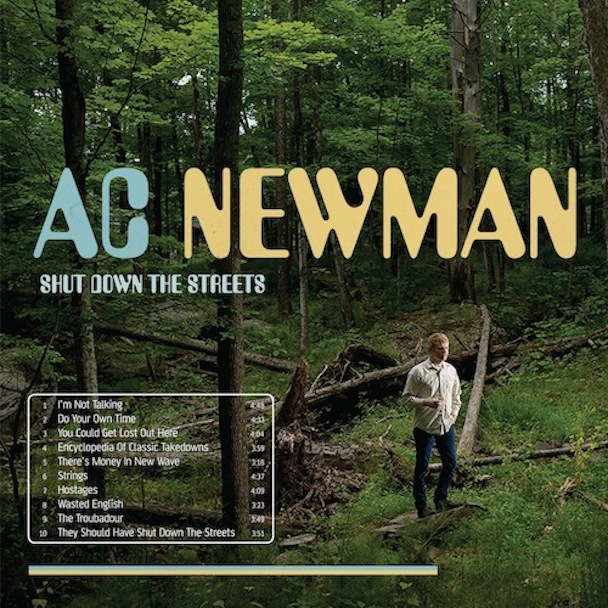
AC Newman – Shut Down the Streets


Rating: ★★★★☆

I know that through his association with The New Pornographers AC Newman often gets stuck in that middling ground between Neko Case and Dan Bejar, but his third solo effort, Shut Down the Streets, is a statement of sorts.  It demonstrates his knack for writing incredible pop songs with lush arrangements, built for longevity in your record collection.

“I’m Not Talking” threw me at first, opening with a few electronic flourishes before the guitar and the rest of the lush orchestration joins in.  It all builds brilliantly, making way for AC Newman‘s voice, accompanied by Neko, to resonate with the listener.  There’s something about listening to that distinctive voice that makes his songs so familiar, but even when the vocals subside, there’s beautiful music in between, which demonstrates the progress he’s made on this effort. In the past, his voice has really stuck out as the sole instrument on his solo recordings, but much care has been placed on the construction and arrangements of these tracks.  “There’s Money in New Wave,” might sound mostly like a guitar strummed ballad, but tiny touches of percussion and string accents bring out the best in this song, making it more than your standard fare.  Oh, and the high pitch of his voice always warms my heart.

But, I can see a lot of people saying that Shut Down the Streets is marked too much by the influence of Newman at the moment of writing this record, himself citing psychedelic-era singer-songwriters.  With that being an obvious influence, I think it actually crafts a broader sound that benefits both the album and the listener.  In the past, there’s always been that difficulty of escaping your main gig, or side gig (whatever he prefers to call it nowadays), with many songs seemingly coming across as polished demos for New Pornos. You won’t get that when you listen to a song like “You Could Get Lost Out Here,” which is an expansive song that unfolds at the typical pace, though brimming with twinkling electronics, eclectic percussive moments and quieted guitar picking.  It’s like AC’s fronting the soundtrack to Peter and the Wolf…with more pop sensibility of course!

Still, if you’re a true AC Newman fan you’ll find heaven in songs like “Wasted English,” a tune that features more vocal accompaniment from Case.  It’s got an accordion that serves as the main backbone here, rather than the guitar, which is present, though distant.  Or you might enjoy “Hostages” for its bounce and spirit, and again, Neko’s appearance. You see, I think he’s always had these tracks inside, but he just need a little help finding a new way to flesh the songs out.  For the most part, Shut Down the Streets is very much what you’d expect from Mr. Newman, filled with splendid melodies/strong ballads, yet he’s differentiated himself slightly.  He’s added a more complete sound by throwing in all the accompaniment at his disposal, filling out an album that’s both warm and rewarding, listen after listen. Surely his best to date.

[audio:https://austintownhall.com/wp-content/uploads/2012/08/a_c_newman_not_talking.mp3]

Download:AC Newman – I’m Not Talking [MP3]

Shut Down the Streets is available now from Matador Records.

1 12 13 14 15 16 61
Social Media Auto Publish Powered By : XYZScripts.com