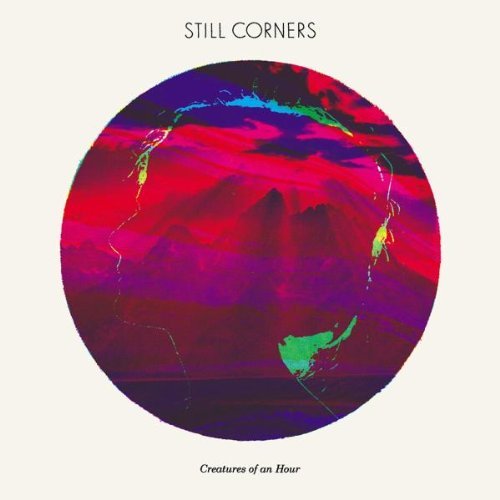
Still Corners – Creatures of an Hour

Rating: ★★★☆☆

If you’re a connoisseur of electro-dream pop, then you’ll know that a little verisimilitude is what separates good from great inside this sub-genre. Sure, you can get some solid jams off of simply interesting instrumentation, but what keeps something in your mind for longer periods of time is the human elements that give it that multidimensional intrigue. In other words, there is an emotional connection of some kind that pushes the music past just wailing guitars or flat vocals. This factor is what divides the tracks on Creatures of an Hour; some prod their way into your psyche while others just dance around the outside.

The first song, “Cuckoo,” easily falls into the category that is able to penetrate deeper. An instant single for Still Corners, it kicks things off with its atmospheric waves of sound. Some bass joins in, increasing the heaviness that this substantial groove already had going and all that is left to complete the dreamy set are the female vocals. Borderline sinister, the sugary vocals tease and pull at the thickset spacey backing, juxtaposing sweet with theatrically dark. Behind Tessa Murray’s voice are some ethereal oohs and ahhs that echo along with the wispy lead. Following “Cuckoo” comes “Circulars,” a brief and to the point synthesizer saturated number that goes nonstop for its length of two minutes. Serving as a mostly instrumental interlude between the first and third numbers, it’s a short little number that adds a little synth spice to the tonal style.

Third on the album is “Endless Summer,” a track that doesn’t so much play on juxtaposition as it does on the overall sound of serenity and calm, with echoes of solemnity swirling beneath. It’s a track that is moderately good, and mirrors the rest of the album. For the most part, Still Corners hold your attention, letting their ethereal dreamy shoe-gaze meander its way into your attention. The first song is unique in that it really demands your focus, whereas the other songs let you come to them. An exception to this phenomenon comes on “I Wrote In Blood,” which implores the delicacy of Murray’s voice alongside loops of swirling synthesizers. It’s got this demented lullaby feeling to it, as if it’s a song for nightmares rather than sweet dreams.

All in all, it’s an interesting sounding album. If you’re looking for a ton of variety from song to song, then Creatures of an Hour may not be for you. If you’re cool with grippingly soft, yet edgy vocals accompanied by winter-perfect hazy pop then by all means, you’re set.

Creatures of an Hour is out now on Sub Pop Records.

Future Islands – On the Water

Rating: ★★★½☆

Although established in 2006, Future Islands seem to be a band that haven’t really been able to get their footing—be it in what kind of sound they are going for, or in the number of full length albums they have put out. Regardless, after a listen or two, On the Water is the album that changes things for this band; it’s a solid synth-pop album with some jams that will have you either bobbing your head to the beat or basking in the glow of their dramatically emotional musings.

Future Islands is composed of three men with synthesizers, vocals and guitars, the combination of which makes for an interesting sound combo. You have these groovy synthesizers that fuse with the passionately gruff vocals of Samuel Herring, which makes up the crux of their sound. Herring belts the words to his songs in his mesmerizing style, pushing every ounce of emotion into every syllable he sings, which drives the sonic interest behind this band and makes the sound more than just some synthesized beats.

On the first song, which is also the title track, you can hear such passion emoted in Herrings vocals. Some atmospheric noise starts things out softly, but then the drum beats and synths roll in and it feels like a beast is crawling over your ears. This image is completed with the entrance of Herring, whose vocals feel strained with raw feeling, even turning into a growl-like state at some points. I’m reminded of a cross between David Bowie and Patrick Wolf in that the throat emotion is the main focus of his style, which may feel melodramatic to some, but proves to be my favorite part of Future Islands’ sound. If you detest it after the first song, I don’t think it would be wise to attempt to pursue this band any further—it is the driving force behind the synth.

There are some standouts on this album that seem to propel it past their last release. One of these comes third and features Jenn Wasner of Wye Oak for some male/female duality in the vocals, and the result is a lovely combination of power. Another highlight comes later on “Give Us The Wind,” in which you can jam to the deep bass of the song and feel the cathartic weight of the lyrics; “We don’t want your blessings/ Give us the Wind.”

While not all songs are exactly the most explosive of numbers, there are enough high points to outweigh the mediocre ones. On the Water serves as a good synth-pop record that will surely warrant further listening.

Crooked Fingers – Breaks in the Armor

Rating: ★★★½☆

Our knowledge of Eric Bachmann predominantly resides in his roll as the main man in Archers of Loaf, but as years have gone by, Eric’s crafted some beautiful records.  Some have been under his own name, but most have come via the Crooked Fingers moniker, and Breaks in the Armor might just be his best non-AoL record yet.

Bachmann has this greatly affecting voice, and it’s this voice that carries album opener, “Typhoon.”  Musically, the song has this dark trickling guitar line, which fits the vocal nicely, as Eric’s voice has this deep wooded quality to it.  By the time we move into the second track, “Bad Blood,” you get two things that Breaks in the Armor is really all about, Backmann’s storytelling, and this sort of alt-country, middling between mellow rocker and Americana.

But, while those elements definitely earn their keep throughout the entirety of this record, there are quieter moments for which I’ve always appreciated Eric’s solo work, especially with Crooked Fingers.  “The Hatchet” is little more than a slow-picked ballad, with Bachmann doing his best to yank at your emotions through the power of his voice.  It’s similar to Merge Records label-mate Richard Buckner, using little more than the vocal to evoke maximum emotion. “Heavy Hours” also lives in this same vein, although you’ll find a bit more of a lush arrangement helping to carry the harmony along, not to mention the help of Liz Durrett on backing duties. For some reason, this track sounds a whole lot like Bill Callahan, not that there’s really any need for comparisons, since Mr. B has been around for so long–perhaps it should go the other way!  If you’re not sure which side to take, listen to “Our New Favorite,” the album closer, before you make up your own mind.

One of the best things on Breaks in the Armor, aside from the emotional storytelling, are those semi-rockers that pop up here and there. “The Counterfeiter” is a gem of a track, and it picks up a rolling movement from the get-go.  In the end, Eric belts his way in and out of the chorus, but in doing so with Durrett (again) he maximizes the song’s emotive quality.  He even has a bit of fun, throwing a little “whoo” in the middle of the track.  These little flourishes have been present throughout the Crooked Fingers period, but it’s the lush arrangements that accompany songs like “Your Apocalypse” that really show the growth  in Bachmann’s writing and recording.

The release date of this record seems perfect, as fall begins to creep into our lives, bringing cooler weather and darker days. Breaks in the Armor is filled with introspective stories, allowing you to search on your own during those days when the rain keeps you inside.  For a man with such a rich musical history, Bachmann’s work with Crooked Fingers only seems to be improving with each continued release.

[audio:https://austintownhall.com/wp-content/uploads/2011/08/Crooked-Fingers-Typhoon.mp3]

Download: Crooked Fingers – Typhoon [MP3]

Loney Dear – Hall Music

Rating: ★★★½☆

As the story goes, Emil Svanangen returned to Sweden after his last trip to the US, holing up in the country with various orchestral and chamber groups.  One listen to his new album under the Loney Dear moniker and you’ll see the grand effect the entire venture had on his writing, leading to a record with lush arrangements and careful touches, the like we haven’t quite heard from Emil.

If you’re reading carefully, you can skip beyond album opener, “Name,” as it really is more of a carry-over from early Loney Dear work.  But, “My Heart” gives birth to a fuller sound.  Accompaniment trickles, but as the song continues forward, you can here bits of electronic bass gurgling beneath, waiting to be unleashed.  It never quite jumps out, but the presence in the background adds a greater density to the track, which is much the case for the entirety of Hall Music.

But, with all the attention to detail, would the music really alter that much in the long run?  It’s a simple answer, no.  You see, the highlight of the group has always been Emil’s voice, a very distinct delivery like that of Justin Vernon, where you realize right away you’re listening to a Loney Dear album. “Loney Blues,” for instance, definitely sounds more complete than many of the songs from Dear John.  There’s a general swell in the construction of the song, allowing the melody to sweep you away in a much more powerful manner than in past outings.  Svanangen’s voice truly carries your listen, especially when you come to tracks like “D Major,” which might just be the best song he’s written to date. A gentle guitar opens, serving as ground zero for the whole track, but the vocals have this pitch that just sits perfectly in the foreground of your speakers.  Once the backing vocals join in during the last minute of the track you can’t help but to get emotionally carried away.

Still, the effort put into the craftsmanship on Hall Music shows that Emil’s really reaching to find a larger sound, one that harkens back to his initial return to Sweden.  “Durmoll” uses horns and string accompaniment to create a song that’s both grandiose and simple, but it works.  Or take a listen to “Maria, Is That You,” which appears as more of a spoken word piece set to studio tinkering.  We should all applaud the man for refusing to put out the same record time and time again, moving ahead as his heart desires.

For most of us, we’ll take our melodies and our pop appreciation, enjoying our simple pleasures.  But, it’s clear that Loney Dear won’t willing accept the status quo in pop construction, pushing himself to create songs that go beyond the basics.  You get the feeling that while he’s several albums into his career, Hall Music marks a huge leap forward into the pantheon of great modern songwriters. Congrats Emil.

[audio:https://austintownhall.com/wp-content/uploads/2011/07/Loney-Dear-My-Heart.mp3]

Download: Loney Dear – My Heart [MP3]

Dum Dum Girls – Only in Dreams

Rating: ★★★★☆

Last year, Dum Dum Girls released I Will Be, an album filled with noise pop riffs and all the girl power you could possibly pack into a single album. This album launched these girls into the fame of the indie-sphere, forever allowing them to be of buzz worthy status. On this sophomore album, they look to branch off a little from their power pop to a more dimensional sound, as to show their diversity.

With so many of the members of this band in various other acts, it shouldn’t come as a surprise that their sound has matured in nature since their last release. It seems as if each lady gained some experience from their individual projects that allowed their collective dreamy pop to feel tighter knit. The first song is “Always Looking,” which kicks things off on a jamming note from the instant it begins. At two minutes and twenty-one seconds, Dum Dum Girls waste no time ad jump straight into the wailing guitars, the sassy powerful vocals of lead singer Dee-Dee and the luscious waves of sound. Already, it is apparent that the sound quality is already triumphant over previous releases.

Even though not much seems to have changed stylistically for these ladies, there is a definitive confident sound that emanates in these jam. Most of the songs hover around the traditional three-minute mark, save for “Coming Down,” but that is a different beast entirely. At six and a half minutes, this song is a crawling delight that ebbs and flows with the angular guitars and that slow resonating drum beats that juxtapose with the honeyed vocals. For me, it is one of the more intriguing numbers that this band has crafted. It is not as though the youthful spirit has been lost, but instead, it is channeled into emotion rather than just fast drumbeats and surface level lyrics. Don’t get me wrong, you can still find this fast and furious pop on Only in Dreams. The next song, in fact, is the epitome of this classic poppy sound with ample jam for you to shake your hair to.

This album is definitely a step in the best direction for Dum Dum Girls. They have taken what was best from their previous releases, perfected them, and then added new elements to spice up their sound and keep old listeners from getting bored. It’s an entertaining album that plays around with what you would expect from these ladies. Have a listen.

Zola Jesus – Conatus

Rating: ★★★½☆

Say what you will about Nika Roza Danilova, her newest album under the Zola Jesus moniker is far from anything associated with goth.  If anything, Conatus is coated in her operatic vocals, touched off by electronic glitches and made beautiful by moving rhythms.

“Swords” begins our foray into the world of Conatus with bleak glitches and Danilova’s haunt drifting far off in the distance.  It’s not the most affecting opener, but it sets up the entrance to “Avalanche” perfectly.  The electronics are altered from their edgy glitch into moving beats.  Nika’s voice takes the forefront here, and it’s exactly as a Zola Jesus record should be, allowing her voice to conquer the hearts and ears of listeners.

“Hikikomori” is the first track on effort where the beats kicks in just a little bit more, and the vocals meet them effectively.  This track is the sort that stands out, both for its minimal approach and its beauty.  You’ll be hard pressed to find something so moving, yet so simple. It’s similar to its successor, “Ixode.” Rhythmically, the song could easily be placed in some dingy bar off the beaten path, but the vocals do well to make the song a bit more artful, rather than letting it slide into kitsch club music. All this is aided by the backing vocals that echo in the distance, giving a softer edge to the track.

But, there are some tracks that could easily be seen as more club friendly hits, if clubs were willing to spin less generic music. “In Your Nature” utilizes a more emphatic dance groove as the skeleton before Danilova completely lets her vocals take over.  Such tracks are meant to be enjoyed while sipping a heady brew, and Conatus, is frankly full of them, demonstrating that Zola Jesus is truly beginning to push the limits set upon Danilova since her first effort.

While the entirety of the album can get a bit thick, making the record difficult to listen to for prolonged periods of time. However, Nika’s voice is so spectacular that she’s allowed a bit of misstep with redundant backing music.  For instance, one listen to “Lick the Palm of the Burning Handshake” and you, too, will be assured of the strength of her vocals.  If you’re not convinced, you can also see the ballad, “Skin,” another remarkable performance. With a voice like hers, she can pretty much do anything she wants with the corresponding music, so who knows where she’ll go next.

For now, Zola Jesus continues to grow, slightly altering the sound, crafting music that perfectly fits the vocal genius of Nika Danilova.  Conatus might way you down at times, but every track on here is filled with careful touches to emphasize the power of the vocals.  You’ll find yourself playing this on cold days, on rainy days and all those days in between; such is the power of the latest effort Zola Jesus.

Big Troubles – Romantic Comedy

Rating: ★★★☆☆

What happens if you remove a bit of fuzz in the production process?  You get a breezy pop gem like Romantic Comedy.  It’s the second record from Big Troubles, and their first from Slumberland Records.  All those looking for a brighter vocal sound, but with the same general feel as the group’s first outing, will certainly be pleased.

You can definitely hear the polish in opening track, “She Smiles for Pictures,” as the guitars have sort of an angular bounce. Vocally, there’s a nice bit of soft comfort in the delivery, sort of like what you’d expect an American Teenage Fanclub to sound like.  But, it’s the next track that will force you to stand on one side of the track or the other.

“Misery,” for all intents and purposes is Pains of Being Pure Heart lite.  Get rid of the scuzz from the aforementioned band’s debut, and you’ve got little gem.  However, I like the fact that the vocals are so clean and clear; it’s something you don’t normally associate with a PoBPaH record, so for me it wins.  Yet, I can see it being derivative, but weren’t the Pains originally the same thing? Perhaps some people grow up faster.  “Sad Girls” is similar here, providing a hint of soft-bit swagger, but the vocals during the chorus are what allow the band to differentiate themselves, sounding much different than the nearest comparison.

Personally, I really like the straight pop gems, such as “Softer Than Science,” which has a bit of the Lucksmiths sense of melody.  There’s a pounding bit of drum work, and the guitars are definitely sharpened.  But, there’s a nice bit of restraint in this number, letting the band focus on their harmonies.  It’s a song that contradicts its successor, “Time Bomb,” the closest track you could call a straight ahead rocker.  The noisy solo in the end definitely reminds you of those 90s guitar moments we’ve all come to treasure.

Yet, Big Troubles faces sort of a problem in the long run.  Romantic Comedy, while definitely enjoyable, wears down listeners quiet quickly.  You’ll likely go from really enjoying the whole record, then the magic begins to fade a bit.  It’s not entirely their fault, as we’ve just been bogged down with so many like-minded records in the last few years.  In order for you to be the best, you’ve got to rise above the rest, and I’m just not entirely convinced the band accomplished that feat.  Still, a good listen from start to finish.

[audio:https://austintownhall.com/wp-content/uploads/2011/07/Big-Troubles-Misery.mp3]

Download: Big Troubles – Misery [MP3]

Quiet Company – We Are All Where We Belong

Rating: ★★★½☆

If you’ve lived in Austin for any amount of time and paid any attention at all, I think it is safe to say you ought have heard of Quiet Company. You may not have listened to their entire discography, but I’m sure the name rings some sort of bell. If you don’t live in Austin, and haven’t heard of this band before…get on it! Time is-a-wastin’. You already have three full-length studio albums to catch up on, and now you have another: We Are All Where We Belong makes four full indie-rock albums to divulge your senses upon.

In comparison to those other albums, this most recent one seems to be the most hook laden. On the first track, “The Confessor,” you get the mellow vocals of Taylor Muse meandering in until the song is more than halfway over, in which some piano bounces up the rhythm and kicks it out of the intro-phase and straight into the jamming. For first song, it is a good indicator of what this album is going to be as well as a good cleansing start for the band. On the next song, “You Me & The Boatman,” keeps things kicking and I’m reminded vocally and musically of early Motion City Soundtrack, but perhaps that’s just me. There is a steady interest maintained.

Five songs in, you get to one of the tastiest jams on here, which also just happens to be the band’s single from this album, “Fear & Fallacy, Sitting in a Tree.” The beginning of the four-minute track is quiet, but some pounding drums help build up the song to the explosive, gang vocal finish, complete with crashing cymbals and even some horn work. “Are You a Mirror,” the song directly following, reminds me a lot of The Decemberists.’ You have the ever-present acoustic guitar and those musical breakdowns with more horns; it’s the kind of music that makes you smile because of the lushness of its sound. Before this song ends, you get the repeated words of the chorus layered over a beat that allows the song to fade to the next flawlessly.

All in all, these fifteen tracks, for the most part, are pretty darn good. You may need to give it a few listens before you’re able to navigate through the jungle of indie-rock to find your favorites, but this is not grueling task, as all of the songs are listenable as well as a testament to local pride. Keep on Keepin’ on Quiet Company.

[audio:https://austintownhall.com/wp-content/uploads/2011/08/fear-_-fallacy_-stitting-in-a-tree.mp3]

Download: Quiet Company – Fear & Fallacy, Sitting in a Tree [MP3]

Twin Sister – In Heaven

Rating: ★★★½☆

Hailing from Long Island, New York, Twin Sister is a primarily chillwave, but also pop band who, according to their website, recorded this album in a rented house during the off season in the Hamptons. Filled with shadows of longing for summer days, In Heaven is solid electro-pop album that serves as a transition from summer into those crisp fall days, or rather, if you live here in Austin, from uncomfortably hot to just hot.

In Heaven packs a punch in the beginning portion of their album. The first song is “Daniel,” which starts with some eerily calm xylophonic sounds that are joined by mechanical sounding drums, which gives the song it’s pick up into dream pop from simple electronic noises. Andrea Estella chimes in with her angelic falsetto vocals that coat the song in a buttery warmth that juxtaposes with the electronic hard that the instruments bring. “Stop,” follows, which jumps right into its groove with the male voice of Eric Cardona leading the way. For a track that doesn’t go very far in four minutes, you would think the sound would get overbearing quickly, but it simmers reasonably groovy for its duration; the dual vocals serving as some kind of cooling agent to counteract the spice of the jam.

Highlights later on come in the form of short little songs like, “Gene Ciampi,” whose prevalent guitar parts move the sound closer to the plain pop as opposed to the computer generated sounds. This track is propelled by the natural guitar, which shows the musical variety that this band is able to pull off. It isn’t an album of all one note. Rather, each song fits with another, but takes liberties from the track before it. Another example of this is apparent on the last track, “Eastern Green,” which builds slowly over the course of four minutes. It breaks from this climax at about three minutes, and gives the album a delightfully soft close, devoid of those harsher elements that were at the beginning.

As far as electro-pop/chillwave goes, In Heaven is a good balance of atmosphere and presence. Due to the production on this album, the vocals are the central focus, allowing listeners to grasp onto something memorable. For this reasons, Twin Sister has got something really going for them. You are sure to find one or two, or maybe even more songs that strike your fancy here.

Dominant Legs – Invitation

Rating: ★★½☆☆

For the past two years, Dominant Legs has slowly been building their brand name, hoping to break into the larger spectrum of the blogosphere.  For the most part the San Francisco duo has succeeded, but the question remaining is whether or not Invitation, the band’s first full length foray would build on that success.  After many listens, perhaps the best thing is that the band hasn’t done anything to dissuade listeners from appreciating their recent rise.

Keeping in mind that the first few songs from an album generally are meant to establish a foundation for the rest of the record, it’s easy to say that Invitation begins just by sort of being “there.”  “Take a Bow” has a ringing guitar dancing throughout, with splashes of electronics bursting in, but for the most part, it’s sort of an unmemorable track. “Where We Trip the Light” attempts to step it up again, using a lighter mood and a bit more playfulness from singer Ryan Lynch.  Sure, the hook’s fairly catchy, generally speaking, but it’s not anything to really shake a stick at.

Perhaps there’s just a bit too much 80s nostalgia coming from Dominant Legs.  “Darling Girls” revolves around sort of kitschy electronics, remarkably similar to something one might find on a Richard Marx movie track, albeit one with a more modern singer.  Surely there’s a market for this sort of throwback association, but I’m not completely buying into it; it seems forced and contrived.  Similarly, “Lady is Sleek and So Petite” uses a very 80s electro-beat to make the song stand up.  For some reason, you can’t help but to recall various scores to movies that you vaguely remember and certainly care nothing about. Sadly, that sometimes is the feeling you get from this entire record.

In comparison to the group’s EP, Young at Love and Life, nothing on Invitation really has that freshness; it all sounds awfully bored and disinterested.  At times, the vocal interplay between Lynch and his bandmate Hannah Hunt is cute and affecting, but Lynch far too often seems like he’s trying to mimic a bit of Dan Boeckner, to no avail.  Even still, those bright moments get nixed by the inclusion of unnecessary saxophone solos.

For all the hype surrounding Dominant Legs, it’s hard to put this listening experience into words.  Song after song, I’m grudgingly reminded of my childhood, forced to listen to FM radio in my sister’s car.  Not a one of these songs is necessarily bad, but for the most part, none of them is really good.  You keep skipping tracks on Invitation, hoping to find one that catches you.  For me, it just never happened. I didn’t hate it, I just couldn’t find something worth coming back to again and again. It’s a large miss in my book, but fans of the band will surely find redeemable qualities in it.

[audio:https://austintownhall.com/wp-content/uploads/2011/08/02-Where-We-Trip-The-Light.mp3]

Download: Dominant Legs – Where We Trip The Light [MP3]

1 25 26 27 28 29 61
Social Media Auto Publish Powered By : XYZScripts.com