Telekinesis – 12 Desperate Straight Lines
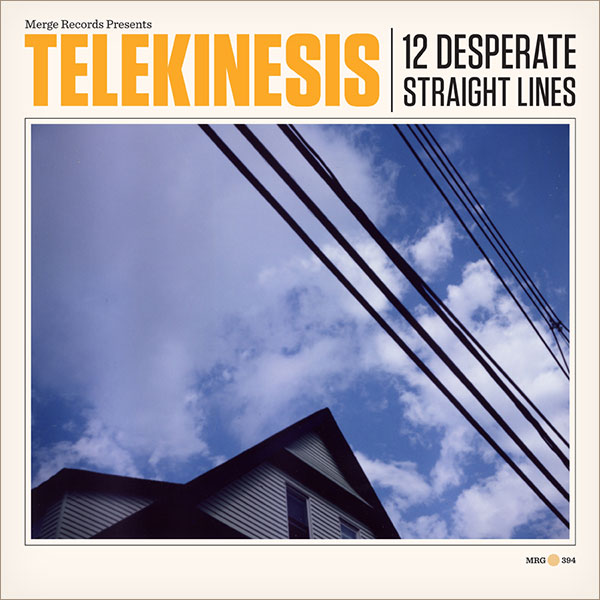
Rating: ★★★★☆

Telekinesis consists primarily of Michael Benjamin Lerner, who won over your attention from his first and self titled album. On 12 Desperate Straight Lines, he looks to keep you in his clutches, locking you in a steady sea of indie rock that will surely create a lasting adoration for this man and his craft.

Beginning with “You Turn Clear in the Sun,” Telekinesis picks up right where thy left off:  the crisp strumming of guitars immediately fill you with a swell of nostalgia for tracks form their last album like “Coast of Carolina.” In fact, these two songs are strikingly similar in that they both start with simplicity and then bust, with the crash of cymbals, into the airy and light sounds that this band has become synonymous with. Lerner’s intricate storytelling lyrics are back in full swing, and so are his borderline nasal-y vocals. However, the band seems to be in a slightly darker place lyrically, as Werner belts “I never loved you/ I’ve never loved anyone.”

This change can be felt instrumentally on the second song “Please Ask For Help,” which calls back on classic sound from the eighties with it’s trembling bass and guitars akin to that of Modern English. The drums punch harshly in the background while the guitar and Lerner echo in waves on the surface. Continuing this transition to darkness comes “50 Ways.” This song starts with a smidge of feedback and then some fairly grunge guitar that welcomes you into the song. However, Telekinesis knows their limits, and pulls back to their softer side, if only for a few seconds. The combination of soft to heavy rock fuses two drastically different textures of music and it works because Lerner’s voice bridges the gap between the two.

 If you listen to every track on 12 Desperate Straight Lines, you’ll be challenged to find a bad song. Each one is a fresh and snappy slice of what makes this band: rapid drumbeats, furious guitars, vital bass and wail of Lerner. By keeping the middle tracks relatively short, the band makes sure that they don’t become banal with their listeners; the only track after the third that pushes past the three-minute notch is the last. That being said, this doesn’t mean that you shouldn’t stop to admire those small songs. On “Country Lane,” my personal favorite song on the album, the band lures you in with the hooks of guitar, then coats their sound with distinct riffs of a higher guitar part, creating one of the albums finer moments.

Telekinesis has succeeded with this sophomore release in that they kept things simple: the tracks are moderately short and fitting, and the lyrics are sharp and witty. However, it’s not much of a jump from their previous album, which is not that problematic on this album, but could prove monotonous for this band if they don’t mix it up for their future releases.

[audio:https://austintownhall.com/wp-content/uploads/2010/11/carcrash.mp3]

Download: Telekinesis – Car Crash [MP3]

The Dears – Degeneration Street

Rating: ★★★★½

When the last Dears record, Missiles, came out, we all knew that there were obvious issues that needed to be addressed.  Amid line-up changes and more time spent collaborating with members old and new, the band have emerged with what might possibly be their best record to date.  Degeneration Street is full of squalls of feedback, great melodies and everything you’ve come to expect from the band.

You’ll begin the journey, and believe me, it’s a trek, with “Omega Dog” offering up a tight little angular guitar riff as Murray Lightburn does his best to approach a nice little falsetto.  There’s a nice little groove, and the guitar riff will definitely resonate with every listener.  Of course, the Dears never stand in place for long, going off into a darker corner of the song for the closing minute, with a fierce little guitar solo accompanied by noisy atmospheric elements.

But, one of the things that makes Degeneration Street so stunning is its ability to shift gears, much as the band does on the second track “5 Chords.”  While other bands bash out their hits in less than thirty minutes, here you’ll find a band building their sound, not only within individual tracks, but with the album as a whole.  This number definitely fulfills the happier pop element present in the record, with sweeping harmonies.  A stomping drum beat helps keep the pace through it all, but please, pay great attention to Lightburn, as its clearly his voice that deserves all accolades in this song.  Similarly, “Thrones” does a great deal to take the somewhat prog-leaning elements into a bit of melodrama, but that’s mean in a respectful sense.  Tiny guttural yelps from Murray signify his playfulness, which we can hope relates to his joy with writing this entire collection of songs.

You’ll never think that the band has gone completely soft after listening here, as sharp-edged guitars are a constant throughout.  Take “Stick w/ Me Kid,” which chugs along a jagged guitar line.  The keyboard or programmable element only furthers the tension in the song, keeping listeners on squirming.  Okay, so the operatic element in Murray’s voice definitely allows you to see a bit of light within the song, as we can imagine him standing in the middle of the audience, controlling us all with his voice as the band rages furiously on stage.

In the end, what stuck with me the most about Degeneration Street was the sense of jubilation that lives within the tracks, despite the usual lyrical content remaining.  Let’s face it, Murray hasn’t always been one for optimism, but even with similar themes intact, you can’t tell me that songs like “Yesteryear,” with its almost danceable beat, don’t portray a man who’s having a blast writing the record he always wanted to unleash.  Just try and tell me that “Easy Suffering,” in title alone, doesn’t paint the picture of a happier frontman. I blame this freedom and joy for one of the stronger tracks I feel the band have written, “Tiny Man.”  It’s a solemn tune, one that surely comes from Lightburn’s personal writing, but his vocal delivery, and the mood just creates something wonderful to witness, especially after following the band from their earliest years. Perhaps I’m a simpleton, but sometimes a step back from traditional habits allows for great moments to burst forth.

Such sentiment seems to pervade Degeneration Street.  At times in the past, they seemed victim of their unstable footing, but musical prowess never fell by the side.  It’s always lived in the writing of Murray Lightburn, and it seems that perhaps with a strengthened Dears line-up, he’s finally been able to fit all the pieces together, as we all hoped he would do.  It’s a sixty-minute affair, with varying styles, various approaches, all settling in the end, leaving listeners with one of the most rewarding listens that I’ve heard in a really long time.

[audio:https://austintownhall.com/wp-content/uploads/2010/11/01-Omega-Dog.mp3]

Download: The Dears – Omega Dog [MP3]

Akron Family – S/T II: The Cosmic Birth and Journey of Shinju TNT

Rating: ★★★★☆

Forget all the hubbub and hype surrounding this release, as Akron Family deserve far more respect that to label their newest record some sort of creation via clever marketing.  On The Cosmic Birth and Journey of Shinju TNT you will likely find hints of the band’s past throughout, but not a group to rest their, they push their sound, and all their influences to new extremes.

“Silly Bears” kicks in with this really heavy riff, and for a minute, you’ll swear you just put on a Sleigh Bells record. Don’t be alarmed though, stomping drums continue, but a slithering guitar line meanders in and out, all the while the band do their best to contain the exuberance in their voices, until it explodes at the 4 min. 29 sec. mark. The track’s bombastic and all over the place, but that’s why its great. Juxtaposed is “Island,” a much slower track, filled to the brim with cinema-like atmospherics atop a hollow drum.  The vocals enter softly “off the coast of Mexico” and you’ll find yourself casually rocking back and forth on some sort of beach hammock.  Such restraint in this moment is why the band’s listens are so endearing, never afraid to go someplace completely different than where you thought you were headed.

Even more shocking for some listeners are the moments when the band give you two contradicting moods within a track, and do it successfully.  Listening to “Another Sky” you’ll get claustrophobic, as there seems to be so much going on; there’s what sound like drum rolls on the rim of the kit, crazy soloing guitars, “oohoohoohs” chanting in the background.  Then a bit of a clap-a-long breaks it all down into something momentarily quiet, resting primarily on the vocals, but the tension still builds to its eventual release.  It’s a brief soft moment, almost a pause, but just the slightest change in formula creates an emotional release for band and listener alike.

Personally, I’ll admit that I like when Akron Family stick to the traditional songwriting mode.  “Light Emerges” uses what one assumes are island percussive elements and just hints of guitar to give the vocals somewhere to walk.  And walk they do, but they also rise high, just before briefly stopping.  It’s then that the band breaks it down for a second, but those elements are then consumed by the song itself, sucked up into the fury that wraps itself around much of The Cosmic Birth and Journey of Shinju TNT.  These types of tracks are far more successful, and appealing, when placed next to noisier moments such as “Say What You Want To,” a song that borders on pure mindless noise at moments.  Yes, there are clear moments of skill and craft within, but rambunctious moments just don’t seem as successful.

Clearly, Akron Family are not your ordinary band, and in being such, they’re not likely to make a record that you can just sit and absorb.  They push your ears in all directions, begging you to deconstruct the songs as you seem fit, filling tracks with as much, or as little (“Canopy”), as they wish.  There are certain times when it all seems to be too much, yet they pull you back in with just a light change in direction in the middle of a track.  Such gentle moves are only a mark of the maneuvering and talent that lays within The Cosmic Birth and Journey of Shinju TNT.

[audio:https://austintownhall.com/wp-content/uploads/2011/01/01-Silly-Bears-11.mp3]

Download: Akron/Family – Silly Bears [MP3]

Bright Eyes – The People’s Key

Rating: ★★★½☆

Having been a long time fan of Bright Eyes, I was really interested to see how his return to the name would go, since I haven’t been overwhelmed, necessarily, by his Conor Oberst output.  For the most part, it’s a return to form, though most people will find that The People’s Key more closely resembles Digital Ash as far as production goes, rather than going the route of lush orchestration that was present on Lifted.

Of course, the album opens with over two minutes of spoken word, which, if you’ve been a fan, is something Conor has almost always used to begin his records, and in doing so, he seems to be stating that while it might have been some time, he’s still treating Bright Eyes as he always has.  Once “Firewall” gets going, you’ll find that his country-twang has dissolved returning him to the more soft-spoken troubadour of old.  And who doesn’t love a bit of Magic Mogis orchestration to accompany his work.

When I first heard “Shell Games,” the piano backbone reminded me of early work on Fevers and Mirrors, except this is definitely a more mature Oberst, one who now should celebrate great control over his voice.  As the song moves along, there’s definitely a more futuristic (read electronic) sound pushing the track.  My favorite line is “I’m still angry with no reason to be,” showing long-time fans that he’s still out there searching for the perfect path, much like the search we’ve all gone upon ourselves. Then to move from a semi-ballad to “Jejune Stars,” well, its a perfect move, while both songs share some sonic similarities, but differences allow for change in perceived mood.  Personally, the stuttering of the guitar lines, not to mention the rise and fall chorus, make this track a stand-out in my mind.

“A Machine Spiritual” opens up with some typical strumming, which slowly retreats into the background of the song as Conor’s voice takes control.  For some reason, his approach on this song, as well as throughout The People’s Key, gives him a sense of rejuvenation, as if he’s gone back to his twenties. He seems gentler somehow, almost more naive, but perhaps this all revolves around his subject matter.  Using bits like “impart to me/your wisdom/and eventually I’ll float into the ether” remind us that one of the great thing about Bright Eyes, past and present, is that he often walks the same path that his listeners seem to take; sometimes we’re all looking at a world we’re not happy with, struggling to find our own meaning, in a world we’re not sure we can necessarily change. It’s this sort of a theme that goes along with “Ladder Song,” that constant pursuit for what it all means, and how we can change it all.  Ultimately, it seems that Oberst realizes we all must live on our own terms, and the song is incredible, if not one of his best.  The fragility in his voice during the chorus, his openness with listeners, and the simplicity of the structure of the song serves as a reminder of just what an incredible writer he is…love him or hate him.

It’s been said that this would be the last Bright Eyes release under the name, and if so, then I’ll admit I’m probably a bit saddened by that thought.  The People’s Key is a reminder of just how amazing Oberst is as a songwriter, and that with his pal Mogis behind production duties, how heartfelt his music can truly be.  If he does manage to leave it all behind, let’s just hope that his new work can somehow manage to encapsulate all the things that make listening to his work great such as spirituality, great lyrics, and a certain nakedness, one that allows us to see ourselves in our favorite musicians. Here’s to that.

[audio:https://austintownhall.com/wp-content/uploads/2010/12/02-Shell-Games-1.mp3]

Download: Bright Eyes – Shell Games [MP3]

Cut Copy – Zonoscope

Rating: ★★★½☆

Cut Copy have been producing synth-pop beats, ever since their first single back in 2001. Since then, they have turned out a few albums that all rely on their capacity to supply excellent alternative songs to put on at your dance parties, whether individual or group. On Zonoscope they look to keep you moving, and for the most part, they do just that.

The first song, “Need You Now,” starts from a small synth beat and then begins to build upon itself, until the vocals of Dan Whitford echo in, akin to that of an eighties electro-pop jam. As it progresses, this song is something like when you shake up a soda bottle—you can see the bubbles forming, building slowly to when the lid is removed and it explodes. Whitford’s deep and ever-so-thick vocals juxtapose with the airy synth and the steady head nod-inducing beat, with some handclaps, to crescendo to a belted chorus and a break down in the beat; an excellent start to Zonoscope.

Keeping up the precedent set by the first song, “Take Me Over,” relies on throbbing bass lines and some more 80’s pop goodness. Throughout the track tangy guitar and kaleidoscope synth, counterbalance with some ooh’s. This song is more danceable than that of the first; matching the brand of alternative dance that Cut Copy does so well. At it’s end, it does not feel like it lasted for over five minutes, but it did, and so did the first song. This is important in the genre of any music that is intended to make people move, as nothing kills a party more than a song that goes for too long in the same direction.

After a quick break from the electro-pop sound on “Where I’m Going,” Cut Copy goes back with “Pharaohs & Pyramids.” Again over five minutes, the band goes many places, but never ceases to make you dance. Following comes another hit on “Blink and You’ll Miss a Revolution.” Sadly, it also marks the dividing line of excellent songs to just plain good ones on this album. The second half of this album pales in comparison to the first in terms of songs that you can move to, and that are intriguing enough to listen to even when you don’t feel like shaking it. What started out as something excellent has meandered into something still decent, but forgettable.

Here is where I can’t help but think that song placement is of utmost importance—perhaps if the band had infused their standouts with the rest of the album, maybe this would have come off as incredible as opposed to brilliant fading to alright. That being said, this album is nothing to turn your nose up at, or at least certainly the first half isn’t.

Champagne Riot – Moonstruck EP

Rating: ★★★½☆

When I first got a press release of Champagne Riot, I expected that one of the participating members of Northern Portrait would bring me more hooks of the angular sort.  Not surprisingly, the Moonstruck EP definitely has plenty of hooks on it, but with a more delicate electronic bend, as opposed to my preconceived power-pop sort.

“Moonstruck” begins the affair with a nice little intro, but then this pounding rhythmic groove jumps in, as electronic beats seem to walk across the track.  Caspar Bock’s voice have this gentle quality that really bring the song together, and while you’re tempted to kick your boots up on the dance floor, there’s a bit of a steadying effect to the song.  Regardless, it kicks off the four-song trek joyfully.

You’ll find a bit more of traditional electronic-pop on “Goldrush.”  Every beat here is a bit more subdued than on the opener, which opens way for this soaring harmonic vocal that really seems to carry the entire track.  This track reminds me of the innocent joy I had as a young kid, when I first busted out New Order‘s Republic, before I worked backwards through the catalogue. Perhaps my favorite element of this song is its straightforward presentation; its not trying to be clever or witty, just wants to be a great track, which it is.

“Heart Stab” is possibly the one track here that just gets to sweet for my ears.  In the mix with a full album, you could probably slide it in nicely, but perhaps too much of a good thing can be bad.  It sounds really familiar too, and perhaps that’s why this song sort of irks me, due to the fact that I can’t place it! Still, there’s a bit of a twisted element in the lyrics, which sort of makes you wonder where Champagne Riot could truly go if they had time to craft an entire record of such music.

Your short journey with the Moonstruck EP ends with “A Friend of a Friend.” You’ll find that this song holds the future for Champagne Riot, as electronic elements are definitely present here, but piano/keyboard touches occasionally dominate the beats themselves, not to mention that the vocal delivery has this soothing quality.  You’ll find somewhat of an operatic montage moment in the latter half of the track, demonstrating that the duo are capable of pushing themselves in regards to their entire sound.  By the end of your journey, you can’t help but to wear a smile.  The tunes are written well, the melodies are great and sometimes we just need to let loose and enjoy this sort of fun.

You can pick it up at the Matinee Recordings Store.

[audio:https://austintownhall.com/wp-content/uploads/2011/02/1Moonstruck.mp3]

Download: Champagne Riot -Moonstruck [MP3]

James Blake – s/t

Rating: ★☆☆☆☆

After releasing a successful EP in Klavierwerke, James Blake gained a spot on Pitchfork’s list of top fifty albums of 2010 and more recognition in the U.K for his distinct sound of electronic beats and dub-step. As a newcomer to this genre, I did not know what all it entitled, but after listening to this album, I can say that it is not the groundbreaking and delightful experience I thought it would be.

The first song, “Unluck,” feels like a complete and utter mess. Random sounds are mixed over an on-again/off-again beat to create for an electronic disaster, unmotivated and cacophonous.  Then James Blake begins to sing, and if it wasn’t already sounding disorganized, his auto-tuned voice adds just another element of contrast that makes it spin out of control even faster. For the three minutes of it’s duration, it feels like a headache inducing CD that is scratched and has been skipping, which is an interesting way (to say the least) to start an album out.

Thankfully on the next song Blake is more calculated, which is shown through the presence of a consistent beat through the whole song. Here on “Wilhelms Scream” is where I can see how this artist has been categorized into the dub-step genre: heavy bass and drum sound dominate the simplicity of the song, consistent with the genres’ description. Blake drops the heavy auto-tune from his smooth voice, so that the song is easier to listen to than the prior. While it is more soothing than that of the first song, it is still the same in repetitive nature. By the end of the song, it hasn’t really gone anywhere, and has been the monotonous repetition of words since the beginning.

After this song, I was ready to ease my ears and switch to something else that was more than electronic noises made by a computer, but I felt like I needed to be fair to Blake in making sure there were no redeeming qualities to this album before I deemed it an utter mess. Six songs in, I finally found a song that was worth listening to: “Limit to Your Love.” It begins with piano, and I couldn’t help but be driven in to the song on the sheer fact that it began with a physical instrument. Blake does revert to his dub-stepping for bits of the song, but it is tolerable in that it doesn’t become plain and boring as the other songs do. This euphoric sensation lasts through the next song, “Give Me My Month,” which sadly only lasts about two minutes. It is in these songs that I feel similarities to Bon Iver, and wish that Blake would have gone the route of only using small amounts of electronic fringe in his work, instead of relying on it to be the very backbone of his sound.

I’m not sure I understand this whole dub step/auto-tuned phenomenon. Is it the kind of genre where you have to be intoxicated or on some sort of substance that alters your perception? Perhaps I am missing something that is the key to enjoying this kind of music because this does not sound pleasurable to me, at all. If dub-step is your thing, then by all means, this album might rank five stars in your book.

The Veils – Troubles of the Brain

Rating: ★★★☆☆

The last time we heard from The Veils on a recording was in 2009 with Sun Gangs.  But, we’re sure to get more from the band soon, as their latest Troubles in the Brain EP indicates. 

You’ll find traditional touchstones of the group throughout this 7 song collection.  “The Wishbone” uses singer Finn Andrews voice to carry the song, whilst the rest of the group uses intricate touches of production and layering to flesh out the rest of the track.  It’s odd, but for some reason I hear a lot of Jason Spacemen in this track. 

Personally, “Grey Lynn Park” is my favorite track on this EP.  Andrews has a bit of a heavier tone to his voice, but it’s the way the strong was constructed that really gets at me.  It’s as if every little piece of instrumentation serves the perfect purpose, making this one of my favorite tracks from the band’s career. 

Of course, these stronger tracks all live at the back end, as the first half of Troubles of the Brain are a little bit bouncier.  It’s not necessarily a bad way to approach the songwriting, but “Don’t Let the Same Bee Sting You Twice” and “The Stars Came Out Once the Lights Went Out” are very similar, perhaps just because of the rhythm.  The latter has a bit of Arcade Fire construction to it, even in the way that the lyrics are composed.  This isn’t necessarily a bad thing, just a bit of commentary. 

It seems clear throughout that The Veils are listening to their peers, as a lot of this EP has touches of current products out in the indie world.  From guitar sounds to the various layers being used, it all has some sort of link.  But, their bread and butter lives in their quiet place, or rather those moments like “Iodine and Iron” when Finn sounds fragile.  These are the moments when Andrews as a songwriter is clearly above so many, and creates the kind of work you wish there was more of in the world.  Troubles of the Mind clearly has indicators as to where the band goes from here.  Either way the band goes, it seems grounded in continual growth, which is never a bad thing.

[audio:https://austintownhall.com/wp-content/uploads/2011/01/04.-The-Wishbone.mp3]

Download: The Veils – The Wishbone [MP3]

The Go! Team – Rolling Blackouts

Rating: ★★★☆☆

So what genre exactly is The Go! Team? Pop, hip-hop, garage rock, alternative dance, or a list of various others? The answer to these questions is all of the above, as The Go! Team dabbles between many different genres, if not plain and simply their own unique combination of sounds. To me, this distinct variety that makes up this group is refreshing while swimming through a sea of simple pop albums. However, at times the group can sound a tad bit too hyper, and the variety can become a little lost on the ears of previous listeners.

This facilitating sound is apparent from the first song to the fourth. On the first track, “T.O.R.N.A.D.O,” those letters are spelled out from the very beginning, with what sounds like a full band of horns, akin to something you would hear perhaps as a pep rally. As you suppress the urge to yell “go tornadoes!” the song ends and transitions to “Secretary Song,” which begins with some chanting like that of the first, but then moves to more of a pop sound, with subtle string work and tinkling sounds of percussion.  At this point, it seems like The Go! Team might only have two tricks up their sleeve, but then they keep adding more to their repertoire.

On “Apollo Throwdown,” a flat out dance groove is thrown down. Gone are the pep-rally and pop sounds, and here are electronic beeps and almost rap (well rap to a white girl like me). If you can make it through this one without tapping your feet, then congrats, you’re a hard ass! This song is a free-flowing all out party-ready groove, encompassing the crazy energy this group has. Following this outburst of energy and dance tunes comes a complete turn in the form of “Ready to Go Steady,” which takes a sort of 70’s sound based off the slightly echoed drums. It’s hard to believe that these two songs back to back are even the same group, as they sound drastically different

If you are a long time fan of this band, then you know that this in not music for just any old day, but music for days that need a boost of explosive energy that The Go! Team offers. A certain mood is required for this group, and Rolling Blackouts is a sure testament to this. At the same time, if you have been a long time fan of this band, then nothing is that new for you in respect to their sound; it’s the same energy, and not a lot of new aspects that keep old timers’ attentions. As hard as this may be to believe, The Go! Team has lost the freshness that they once had. Granted, Rolling Blackouts is nothing to turn your nose up at, but it’s not something to stop everything for.

[audio:https://austintownhall.com/wp-content/uploads/2011/01/thegoteamvoiceyrchoice.mp3]

Download: The Go! Team – Voice Yr Choice [MP3]

Apex Manor – Year of Magical Drinking

Rating: ★★★½☆

So what do you do if you’re Ross Flournoy and your band has just finished their productions as a group? Keep writing songs and diving further into the musical world, of course. In 2009, when The Broken West ceased existing, Flournoy continued his work alongside former band mate Brian Whelan, and also his new roommate Adam Vine— thus creating Apex Manor, a new group for him to belong to. The result is a power pop bang of goodness that will have you jamming along with the distorted guitars.

“Southern Decline” kicks the pop party right from the start. Flournoy spins the story of getting “high, while [he] feels low,” with guitars strumming away, juxtaposing such a negative subject with strong instrumentations. “Under the Gun” then follows and you can see the crystal clear and masterly executed production of Dan Long (who produced such bands as Local Natives) shining. Just enough distortion on the guitar parts fills all the nooks and crannies of this song, so that there are no holes for the airy percussion elements to slip through.

Three songs into the album comes my personal favorite “The Party Line.” Just when you think that The Year of Magical Drinking is going to be just another pop album, Flournoy throws in this number and you’re hooked again. Gentle, undistorted plucking of guitar begins the song and then the beat gets going and some more rock feeling washes over, making your head bob and fingers tap. It’s pure bliss for three minutes and fifteen seconds, even during the short return to quiet that comes before the final chorus. It’s a song that’s meant to be blasted, and blast it you must.

 Accompanying the previous track is another less pop, more rock song: “Teenage Blood.” The repetitive line of “I’ve got teenage blood/boiling in my brain” resounds, and for a second, you almost believe that perhaps there is a little bit of angst in Flournoy; the vocals stray from their refined execution, and the cymbals crash chaotically, but within a few minutes, the band is back to their style—a nice deviation and then return, so that they can finish strong. “Holy Roller” slows things down for basically the first time on the album and Apex Manor shows yet another side of their musical talent; a sort of bluesy , soft rock flair, without the cheesiness of course.

For their first full-length album, Apex Manor has done well. While not the most ground breaking sound, they combine pop with rock, and solid production to match their every beat. I enjoyed it quite a bit, and it is a very good example of what mostly pop albums should sound like. Here’s to hoping for excellent future albums from this fine group.

[audio:https://austintownhall.com/wp-content/uploads/2010/10/02-Under-the-Gun-1.mp3]

Download: Apex Manor – Under the Gun  [MP3]

1 37 38 39 40 41 61
Social Media Auto Publish Powered By : XYZScripts.com